Spy Robot v1.0

Everything started from the desire of exploring new territories and collecting data. I chose a RC car as a platform whereon I have attached an Arduino Uno board, temperature, humidity and pressure sensors and a pan & tilt system (2 servos). This system has a web cam holder in order to collect videos and images through a smart phone using Skype. The pan & tilt system is controlled by a Wii nunchuck in real-time. More information about this topic in this tutorial.

SAMSUNG

The communication between Spy Robot and me is achieved by means of two Arduino boards (one placed on the platform and the other one connected to my PC)  which see each other via bluetooth. The video is transferred separately using Skype. Thus, I can see what Spy Robot sees, by controlling its eyes (the camera -smart phone-) with the Wii nunchuck. Meanwhile, I can analyse the information collected from sensors (also in real-time) on the terminal.

SAMSUNG

Yesterday I won the first prize in the regional stage of robotics contest for my robot and I qualified for “Infoeducatie” National Contest, robotics section that would take place in two months. To this respect, I intend to add an arm to my robot, in order to be able to grasp objects that Spy Robot sees during its explorations.

Electrical & cooling system

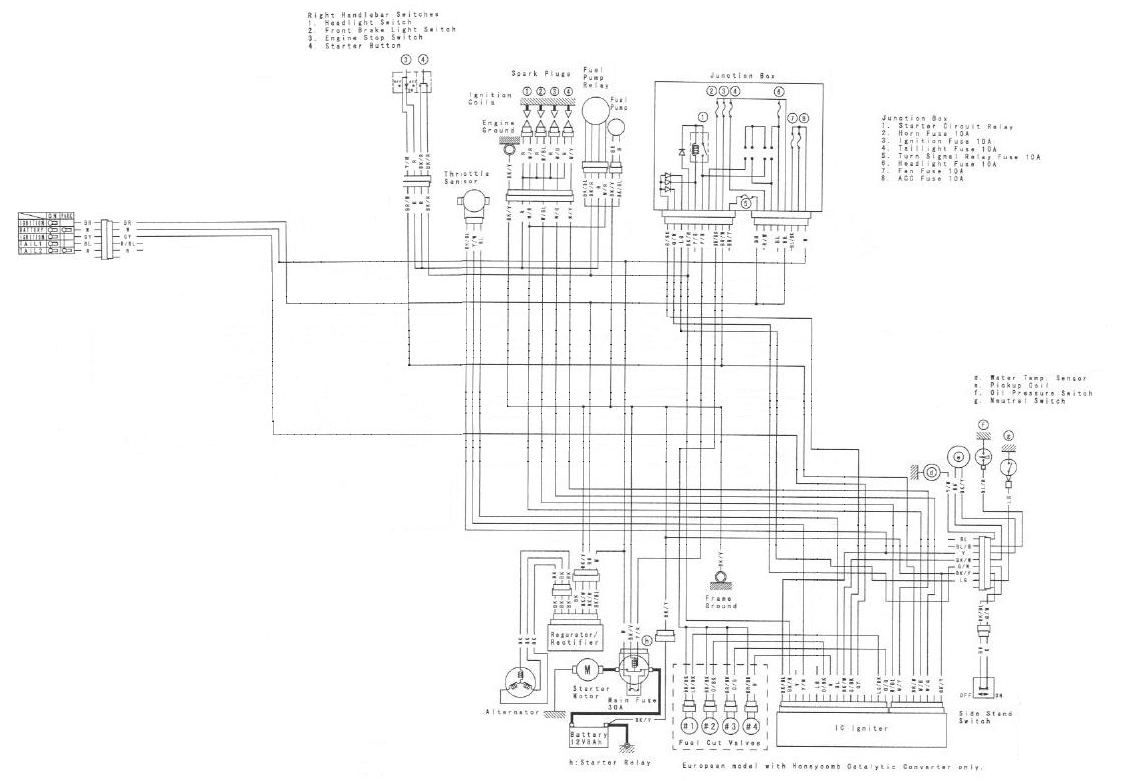
I had some issues with the electrical system as the old motorcycle had many sensors and lights which are unuseful for me, but after consulting the electrical diagram, everything was fine. I have eliminated the extra wires and after a few hours I have simplified the diagram by 60%.

Before:schema originala

After:schema.2

I did the wiring and as a result, the engine started!

As far as the cooling system is concerned, I attached a water radiator taken from a generator. I placed it at the back, but it will be assisted by an Audi fan in order to maintain the air flow.

photo(2)

Transmission

A few days ago I received the 50 mm diameter bar ordered at the turner, with the proper dimensions I have designed. The ends of the bar are threaded in order to match with the Ford Mondeo II hub carrier secured with nuts. It has also a specific dimension somewhere in the middle for the mid-bearing and the brake disc. The wheel gear is at a third from the left end of the bar and it is also custom-made in order to have a specific power ratio and reduce the speed. The original toothed wheel had 38 teeth and because I needed more torque power I replaced it with a 60 teeth one.

photo

Now, I have to add a 12 teeth wheel as a tentioner for my transmission. I want to do this in order to maintain the chain tensed even in off-road situations.

Steering system & Suspension

This has been the most difficult part so far as I had to adjust every piece in order to fit to my project. I bought some parts such as the front suspension and wheels, steering knuckles, steering box, steering wheel and the strut bar from a Tico car. I have chosen these parts because Tico has MacPherson suspension which is very easy to implement.

SAMSUNG SAMSUNG

I have also attached the pedals from an old Dacia.

Until now, the steering is responsive, the geometry is ok and I shouldn’t have any problems in the future.

Engine

I have been searching for a suitable engine since I bought the plans, but last week I found one laying in a garage. It is a Kawasaki ZX600 motorcycle (Kawasaki Ninja ZX-6R) from ’98 which has incurred an accident. I paid for it 400 €. The front is undone, but the engine is in perfect condition. It has 10.00 km, 75 kW (100 hp) @ 12500 rpm. I chose it not only because it is compact and has a 6-gear gearbox included, but it is powerful at the same time.

SAMSUNG

I have designed and build a framework for it in order to be easily unmounted and to have fully access to it for further changes.

Chassis

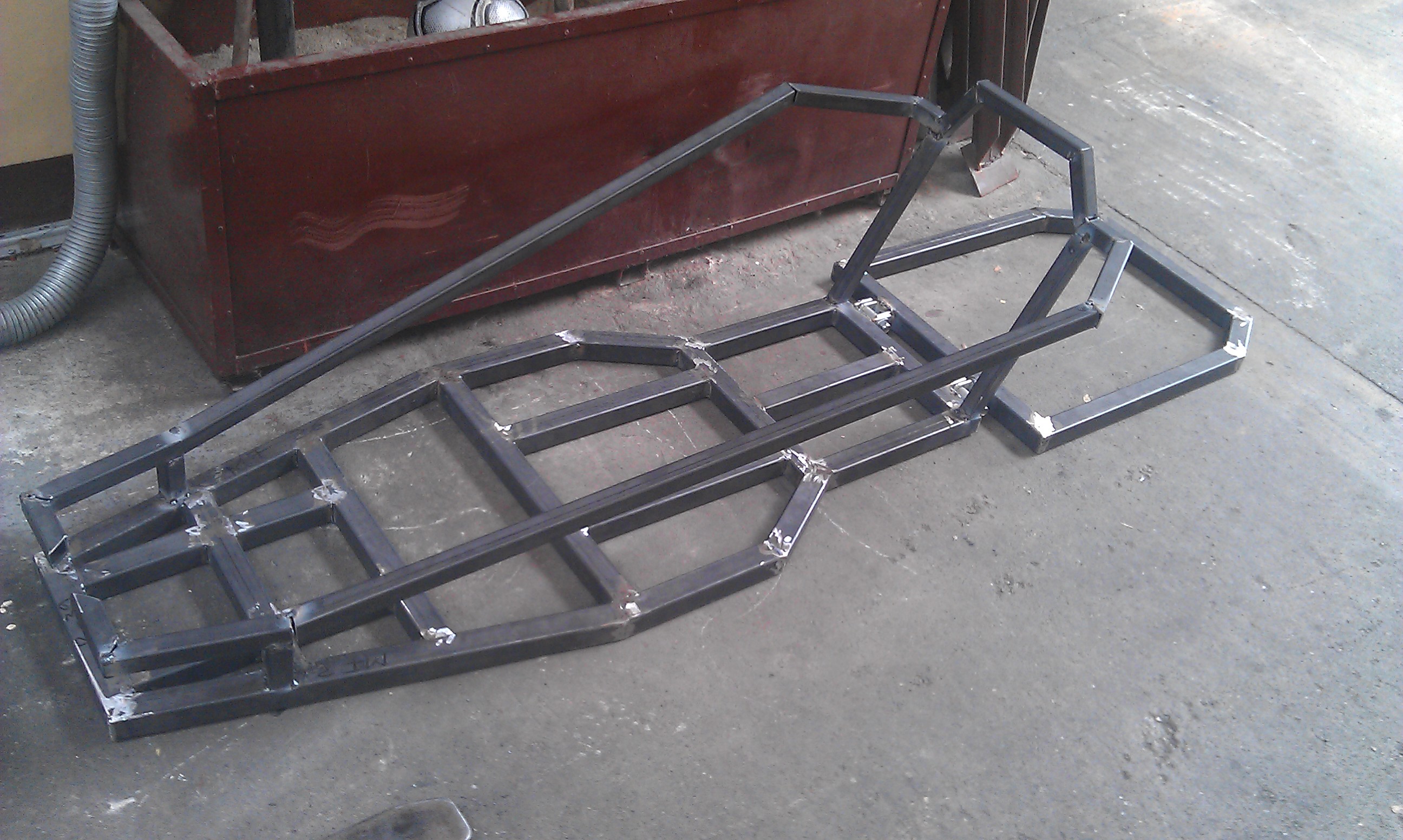
After so many hours of welding and cutting the iron, it finally took shape. I am very proud of what I’ve managed to do in the last week starting from those plans. The result is the following:

IMAG0192 IMAG0196

I’ve stuck to the plan up to a point where the engine mounting and the steering system were involved. I have to adapt the chassis in order to fit the parts I need. Now, it is just spot welded, but I will strengthen it soon and I will come back with the next step: The engine.

The plan

After a brief research, I bought a $35 buggy plan as a source of inspiration and a starting point for my project. I have chosen this buggy and I have already made a list of what materials I need for the chassis:

  • 40 Feet of 1 1/4″ x 1 1/4″ #14 gauge square tubing;
  • 40 Feet of 1″ x 1″ #14 gauge square tubing;
  • 2 foot of 1 1/2″ x 1 1/2′ x 1/8 thick Angle Iron.

I will have to change some parts of the plan, such as the engine mounting or the steering and suspension system, but broadly I will respect the aspect of my Arachnid Buggy.

arachnidfront

Inspiration

Last week-end I met my friends at karting, somewhere in Pipera. The race track has about 2 km and they have 2 types of karts to rent. Some of 6 hp and some of 13 hp which speed up to 80 km/h. We chose the powerful option and did some laps. I was very fascinated about this sport and I found out they have even driving courses I am very interested in. I started to look for a kart as I wanted to follow a career in this type of sport. My father supported me up to a point, when, I had to purchase my kart which was quite expensive. Quickly after that, he gave me an idea saying: “Why don’t you build one of your own?”. It took me only one second to go to the computer and search for “DIY kart”.

There are a lot of tutorials about building your own kart and searching for it led me to its bigger brother: The Buggy. It is a one-person car with full suspension designed for off-road conditions. It means more hours of hard-working than building a 10 hp kart, but it’s worth. I found a website which has different types of buggy plans and I decided to draw inspiration from them.

barracuda-edge-buggy-kart-3

(source: http://silodrome.com/barracuda-edge-buggy-kart)

RC car tunning

One of my favorite hobbies is driving a remote-controlled car. This is why I own a HPI Trophy Buggy (1:8 scale)with a 2.5 hp engine which runs on nitro fuel. It speeds up to 60 km/h which makes it a dangerous hobby. I drive it on special race tracks where children have no access.

I have started to adjust my car and boost its performance in order to do quicker laps. I have changed the gear ratio from 21:1 to 18:1, for having more speed and less power. I have changed the brakes and suspension, I have changed the oil from the 3 differentials (one in front, one in rear and one in the middle) with a less viscous oil in order to get rid of extra friction between gears.

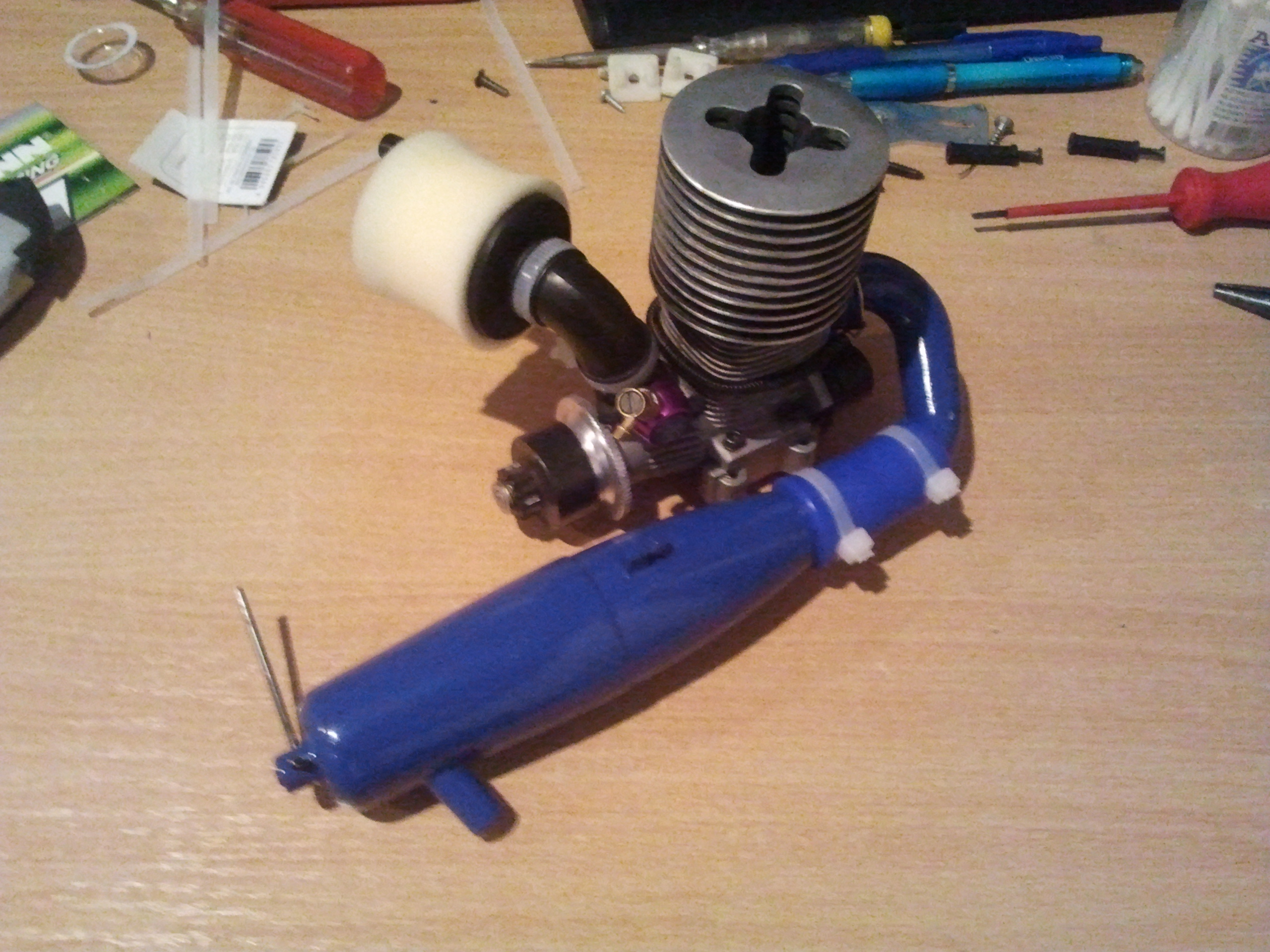
This is the engine with a new clutch, air filter and exhaust pipe:

SAMSUNG

After several weeks of adjusting, the buggy looked as following:

SAMSUNG

Tyres are one of the most important parts of the buggy. I have changed the original ones as there were soft with harder ones.